
The Score uses cookies. By continuing to browse this site you are agreeing to our use of cookies. Click here to find out more »
Dublin: 9 °C Friday 24 May, 2013

Adjusted for population, Ireland came fourth in the Paralympics

We’ve crunched through the Paralympics medal table to reveal just how well Ireland really did…

Jason Smyth, Mark Rohan and Michael McKillop each show off their two Paralympic gold medals.
Image: INPHO/Cathal Noonan

WE’RE ALL AWARE of the phenomenal medal haul achieved by Ireland’s representatives at the 2012 Paralympic Games, which amounts to Ireland’s best medal haul for a quarter of a century.

But we’ve had a quick re-crunching of the numbers – and it turns out that the Irish of 2012 really were among the best in the world.

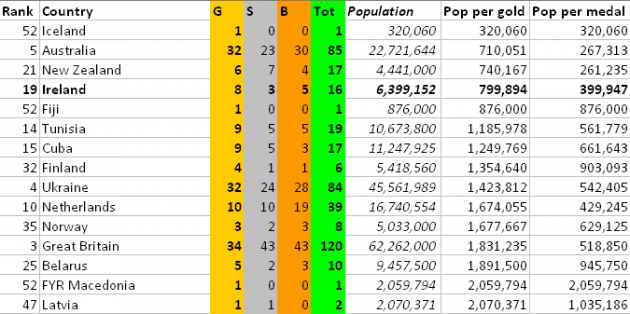
When adjusting the medal count to consider the population of each country, Ireland does far better than the 19th place it took in the outright table. In fact, the athletes of Ireland come fourth.

The haul of eight golds, three silvers and five bronze medals adds to a total of 16. When split among the population of just under 6.4 million (the all-island team includes athletes from both the Republic and the North) it means one medal per 399,947 people.

Only three countries can better that: Iceland (whose solitary medal, a gold, is split among the population of 320,000), Australia (85 medals for a population of 22.7 million) and New Zealand (4.4 million people, 17 medals).

When including only golds, Ireland is still fourth behind the same countries: Iceland tops the list, with Australia’s 32 golds putting it second and New Zealand’s six medals ranking it in third.
If we change the table and rank it by the wealth of each country (expressed in this case as its GDP, or the size of its economy) then we’re still well above average – coming in at a respectable 14th place in the cash-for-gold table.

IMF figures for 2011 show that Ireland (or, at least, the Republic of Ireland) produced $217.7 billion of goods. If you were to link this to the performance of our athletes, you could then say each gold had ‘cost’ Ireland $27.2 billion.

That’s much more than the $3.46 billion that Fiji paid for its solitary gold medal, but significantly less than the price of a gold for China ($76.8 billion), Great Britain ($71.1 billion) or the United States ($486.9 billion).

Proof, if you thought you still needed it, that Ireland’s Paralympians really are among the best on the planet.

Gallery: Welcome home! Ireland’s medal-laden Paralympic heroes return

Read next:

Comments (14 Comments)

  • Fantastic! Congrats to our Paralympians. They’ve done themselves and the country proud. I’ve run out of superlatives to describe their achievements.

    Reply
  • Excellent, great news…

    Reply
  • Ammm, it’s a bit of a stretch to include the entirety of Northern Ireland ‘s population when calculating for Team Ireland seeing as some athlete from NI competed for Team GB or am I mistaken? If anything, to get the best/most accurate fit you should be a comparison of the ratio of NI athletes competing for Ireland and those competing for GB and apportioning the population along this ratio before doing the above calculation. I’ve seen per capita analyses done that have Ireland in 3rd.

    Reply
    • In fact if you use the population of ROI only (equally inaccurate IMO) we are 2nd on the gold medal table and 1st on the per medal table proper!!!

      Reply
    • But then you will have to minus the 5 gold medals won by NI athletes, now where does it leave Ireland in the table :).

      Reply
    • I’m not saying deduct, I’m saying to proportion it. Out of the 6 NI athlete that competed, 4 competed for Ireland and 2 for GB. Perhaps adding 2/3s the population of NI to the ROI would be more appropriate from a statistical analysis point of view. (Likewise one third of Norn Iron’s population would be added to GB’s total).

      Reply
    • Just did hte maths on it. All this would change is the per gold table where we move to 3rd but over all remains at 4th. Statistics aside though: a magnificent achievement by some of the most extraordinary people this island has ever produced. Looking forward to their continued success in Rio 2016!

      Reply
    • Hi Eoin – I knew that decision would get picked up by someone! While obviously splitting the population into those who identify as ‘Irish’ or ‘British’ would be the simplest option, it seemed like a diplomatic no-no given that, technically, the vast majority of people within Northern Ireland would be legally eligible to represent either Ireland or GB (given that Irish law offers Irish nationality to anyone born there). The only sound answer in that case is to think of Ireland and GB as overlapping circles in a Venn diagram with the population of the North as the overlap, where 100% of its population appear in both groups.

      As has been pointed out, Northern athletes also secured a disproportionate amount of the medal haul – to be honest I suspect if Northern Ireland was a standalone entity (like it is for the Commonwealth Games), and all the athletes who could had opted to represent it, it would have been close to the top of the whole thing…

      Reply
  • Ah yes,superlatives,there’s a word we have heard a few times over the Olympics…..
    I couldn’t care less,north or south of the border, they wore green and made us very proud of them. Well done again

    Reply
  • I was studiously trying to avoid commenting on that!

    Reply
  • Could you not come up with another word for ‘haul’? Medal tally, total, bonanza…get out your thesaurus :-)

    Reply
  • McKillop and smith are northern Irish

    Reply

Add New Comment