100 CAPS, TWO Premier League winners’ medals, a place in the Uefa Team of the Year — not many Irish footballers come close to matching what Damien Duff has achieved in the game.
The Dubliner announced his retirement today, bringing to an end a glittering 20-year career in football.
Despite a career dogged by injuries, Duff even in later years — when many one-time pacey wingers have been consigned to obscurity — remained in relatively rude health, literally and figuratively. The reaction to his Shamrock Rovers debut back in August served to highlight the substantial esteem in which he continued to be held with Irish football fans.
Duff’s performances over the years have been a testament to the player’s inherent professionalism and a sign that, even as his career approached its conclusion, his passion for the game remained undimmed, as he alluded to in the classy statement that coincided with today’s news.
Indeed, what has defined Duff, as much as his footballing ability, is his unblemished attitude. Largely thanks to the lucrative contract his agent negotiated for his Chelsea move amid the onset of Abramovich-era excess, Duff ultimately became one of the highest-earning Irish athletes of all time. Yet, in most people’s eyes, he still remains that boy who constantly played football on the streets of Dublin and spoke of a curious penchant for excessive sleeping.
There is a palpable level of modesty in the way Duff invariably conducts himself. In an age where obnoxiousness and controversy, in the form of ill-advised Twitter outbursts (James McClean), tabloid scandals (John Terry) and unseemly race rows (the Evra-Suarez debacle), looms large over Premier League football, Duff was always a shining anomaly, a beacon of dignity in a world where the quality is in conspicuously short supply.
For instance, in contrast with many more selfish players with similar levels of talent, Duff did not make a transfer request or refuse to play during his respective stints at Blackburn and Newcastle, even in aftermath of both their relegations.
Indeed, his eventual move to Chelsea from Blackburn would have been seen as a no-brainer for the average footballer, but it was one Duff thought long and hard over. At the time, it was even revealed that it genuinely pained him to depart the club he had joined as a youngster — if only certain other patently disloyal and ostensibly money-obsessed footballers could follow his example.
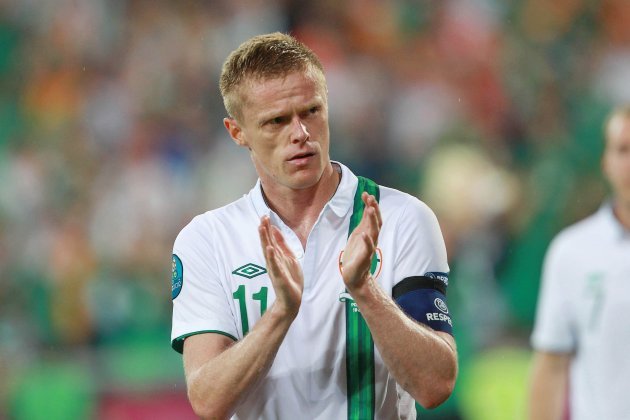
Yet Duff is rarely talked of as a sports star that this country should be proud of, in the same way figures such as Brian O’Driscoll and Katie Taylor are routinely and deservedly commended. Neither is he even spoken of in the same awed terms as more divisive characters, such as Roy Keane.
Granted, the former Lourdes Celtic youngster’s success has never been quite as significant as the three aforementioned names. However, two Premier League titles, two League Cup winners’ medals, a Europa League final appearance and several influential games in both the World Cup and the Champions League is nothing to be sneered at, especially in an era in which merely playing in Europe’s biggest club competition is a significant achievement in itself for an Irish player, given the intensive competition for places among the top teams in English football nowadays.
So, the question remains: why is Duff rarely celebrated? His £17million transfer sealed in 2003 is still the second highest-ever paid for an Irish footballer and this stat, as much as anything else, is surely evidence that he deserves to be considered among the greatest footballers the country has ever produced. And yet, there is a lingering tendency to readily downplay Duff’s achievements. There is a sense that, for all the extraordinary feats he accomplished at Blackburn and Chelsea, he never really reached his full potential.
Nevertheless, those who subscribe to this notion are being somewhat unfair. The primary reason why Duff went from being an exceptional player worthy of competing for title contenders, to a merely very good one capable at best of holding down a place in a mid-table side, is largely down to a series of unfortunate career-hampering injuries he suffered, which robbed him of his lightning pace.
But what makes Duff special is the way in which he has reacted to such setbacks. Far from not living up to his potential, from another perspective, he has maximised his effectiveness under the trying circumstances that he’s been forced to endure since entering his 30s.
Like Brian O’Driscoll and several other sporting icons, Duff demonstrated the requisite intelligence to adapt his game as he grew older and more susceptible to wear and tear, in order to maintain an impressive level of consistency, enjoying a particularly successful spell at Fulham, when many had written the Irish star off after he left Newcastle following their relegation.
Although he probably won’t thank us for saying it on account of his shy nature, for all he’s achieved both as a footballer and a person, Duff deserves to be treasured as loudly and as vehemently as any other athlete from these shores. Just don’t expect him to join in the cheerleading if it does belatedly transpire.
A version of this post was originally published on 23 February 2013