The Score uses cookies. By continuing to browse this site you are agreeing to our use of cookies. Click here to find out more »
Dublin: 7 °C Wednesday 22 May, 2013

Eight Olympic badminton players charged over ‘not trying’ in matches

Four pairs in the women’s doubles competition – one from China, one from Indonesia and two from South Korea – were booed off court by irate spectators at London’s Wembley Arena yesterday.

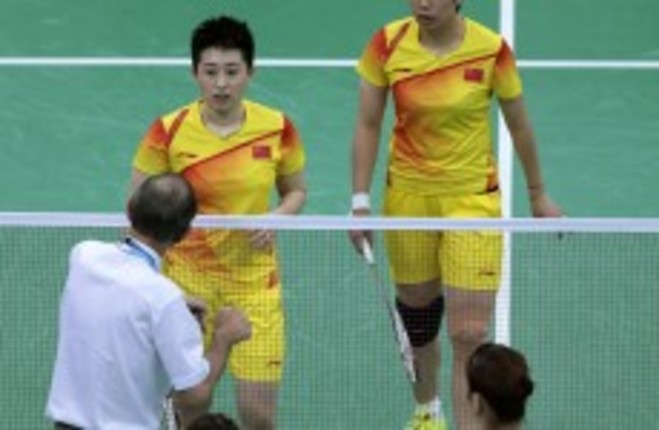
An official intervenes during the match between China and South Korea at Wembley Arena in London.
Image: Saurabh Das/AP/Press Association Images

THE OLYMPIC BADMINTON tournament was thrown into chaos today when eight women players were charged with trying to “throw” matches to secure an easier draw in the next round.

Four pairs in the women’s doubles competition – one from China, one from Indonesia and two from South Korea – were booed off court by irate spectators at London’s Wembley Arena yesterday.

The players in two matches had appeared to deliberately serve into the net to concede points, hit the shuttlecock out of play, or waste time.

They could be disciplined after the Badminton World Federation (BWF) charged them with “not using one’s best efforts to win a match” and “conducting oneself in a manner that is clearly abusive or detrimental to the sport”.

A hearing is due to take place today, although all four pairs are currently still included in the order of play for their quarter-finals scheduled in the evening.

The players were allegedly attempting to manipulate the final standings in the first-round group stage, with two pairs who had already qualified apparently wanting to lose to secure easier opponents in the next round.

A match between China’s world champions Yu Yang and Wang Xiaoli and unseeded South Korean pair Jung Kyung and Kim Ha Na came under scrutiny after the Chinese lost a contest they would normally be expected to win.

With their defeat, Yu and Wang avoided playing another fellow Chinese pair who had finished second in another group, in the quarter-finals.

Yu said after the match: “We’ve already qualified, so why would we waste energy? It’s not necessary to go out hard again when the knockout rounds are tomorrow.”

China’s Olympic delegation – already fighting off accusations of doping against teenage swimming sensation Ye Shiwen – has launched an investigation into the badminton allegations, state media said.

“The Chinese Olympic Committee… opposes any kind of behaviour to violate the sporting spirit and morality,” a Chinese Olympic spokesman told Xinhua news agency.

A later match in which South Korean third seeds Ha Jung-Eun and Kim Min-Jung beat Indonesian pair Meiliana Jauhari and Greysia Polii is also being investigated by the governing body.

- © AFP, 2012

Today: Olympic breakfast: There’s no show like a John Joe show

Read next:

Comments (33 Comments)

  • They might have well just have tossed a coin. Badly organised that this could have happened on the first place. Similar thing happened in football until games were played at the same time. Not exactly the same as this but shows that organisers need to act accordingly.

    Reply
  • Can someone explain what the South Korean’s did to get disciplined? Where they trying to throw the game too? it appears from this article that the Chinese pair and the Indonesian pair were playing and attempting to lose against the two South Korean pairs. What am I missing? Cheers

    Reply
    • Anita, it seems that once the Koreans realised what the Chinese team were up to, they too started deliberately serving into the net and hitting shots out and the whole thing turned into a farce. As some comments above say, it happens in other sports, but this seems to have been a bit blatant.
      Both teams in the second match were almost disqualified by the event umpire, but it seems that they pleaded with him to allow the match continue, and actually played properly from then on.

      Reply
    • Cheers Stuart.

      Reply
  • John F 01/08/12 #

    One is truly outraged at the thoughts of one not using one’s best effort!

    Reply
  • A cheat can never be a winner, if you fool yourself by thinking you are a winner by cheating then you are a fake. Not the type of person any decent person would want to know really. Just my opinion.

    Reply
  • They do it in major football championships all the time. Move on. Hope they win the semi tonight, at least they are now motivatef more than ever.

    Reply
  • Down with this sort of thing!

    Reply
  • I know it’s not great to lose on purpose but it makes sense not to push themselves too hard in the final game when it’s meaningless. Look at other events where athletes slow down near the end when they are assured of qualification. May not be sportsmanlike but in the Olympics it’s all bout winning.

    Reply
  • So strange to see the chinese not playing by the rules and cheating even?

    Reply
  • Why isn’t it a knockout format, like most other badminton tournaments? Would avoid this kind of situation….

    Reply
  • In the true noble Olympian spirit, it is not the winning that counts but the taking apart of the games.

    Reply
  • Rick Li 12/08/12 #

    Olympic athletes want to win — we all know that. So why are they being disqualified for trying to lose? After the badminton scandal that marred the early days of the games, the latest athlete to be kicked out was Algerian middle-distance runner Taoufik Makhloufi, who walked off the course in an 800 meters semifinal on Aug. 6.

    Makhloufi got lucky. After an appeal, the International Association of Athletics Federations accepted the doubtful excuse that he was feeling injured, and reinstated him. The next day, Makhloufi won the gold medal in the 1,500 meters by almost three-quarters of a second.

    That was not the performance of an injured man. Makhloufi hadn’t wanted to run the 800 at all. For some reason, his team had left him in it. Clearly, Makhloufi knew his chances of winning gold in the 1,500 could be harmed by running the 800, which he had little chance to win. He was acting rationally in giving up. For that matter, so were the Chinese, Indonesian and South Korean badminton players who tried to throw early-round matches for a better draw in subsequent tournament rounds. So was the Japanese women’s soccer team, which benched all but four starters and played for a tie against South Africa to avoid having to travel to Scotland for its next match.

    ——————————————————————————–

    MORE: Analysis and discussion from Viewsday | Newsday columnists | More opinion

    CARTOONS: Walt Handelsman’s Cartoons | National Cartoon Roundup

    ——————————————————————————–

    Why, exactly, do we have the instinct that acting rationally to win violates the “Olympic spirit”? The rules of the International Association of Athletics Federations, which governs Makhloufi’s races, demand that athletes “compete honestly with bona fide effort” or face mandatory elimination from future events in the same competition. The badminton rules are roughly the same.

    Of course, all the athletes in question were putting in a bona fide effort to win gold medals. They just believed that the best way to do it was to focus themselves on the main event and put themselves in the best possible position for it. That path took them through a less than fully competitive effort in earlier matches or races. There was nothing inherently dishonest about their efforts, except that the rules require them to lie if they want to have the best possible chance of winning.

    One possibility — the one the Olympic authorities would no doubt like us to embrace — is that competitors should go all out at all times, treating each moment of competition as sacred. After all, the Olympics have their origins in ancient religious ritual, and today sport can seem very much like a secular faith, complete with rituals like sacred flame and a solemn Olympic oath.

    The problem with this ideal is that it does not match reality. We see strategic competition all the time in sports, including the Olympics — and ordinarily, it does not bother us much, if at all. We compliment the intelligence of runners and swimmers who pace themselves in preliminary heats, rather than expending all of their energies. We accept the intentional walk in baseball as part of the game, even though it represents the opposite of bona fide competition between pitcher and batter.

    We even accept that professional basketball and football teams will play their scrubs and accept near-certain defeat once they have made the playoffs — not just to protect against injury, but sometimes even to get a better playoff draw by losing.

    Perhaps it could be argued that the badminton players, at least, violated the spirit of the tournament, which was designed so that the qualifiers from the initial pool would then compete in the next round according to a predetermined set of rankings.

    Yet it was the tournament’s design that created the incentive for the teams to lose. In essence, the matches that the players were attempting to throw were exhibitions: All the teams involved had already qualified for the next round.

    Indeed, it could be argued that Makhloufi’s tanking (if that’s what it was) was worse than that of the badminton players. At least they were easing up within the context of the same tournament they sought to win. The runner, by contrast, was throwing one event to have a better chance of winning an entirely different one.

    The persistence of strategic competition despite the rules against it suggests another reason that the Olympic Games condemn the practice: the entertainment value. The Olympics are a big business, and organizers want the spectators to get their money’s worth. London Olympics chairman Sebastian Coe inadvertently revealed this motive when he commented after the badminton scandal, “Who wants to sit through something like that?”

    By this logic, there is nothing sacrosanct about Olympic effort except that the spectators have paid good money to watch it while the networks and the sponsors have paid vast sums to show it. Far from embodying the aspiration to pure sport, the athletes are entertainers. As entertainers, they owe their responsibility not to ultimate victory but to putting on a good show at any moment when a paying customer might be watching.

    Once the underlying economic motive emerges, it’s easy to see that there is a conflict between our interests as consumers and the athletes’ as producers of value. From the athletes’ perspective, ultimate victory really is the goal. Not only do they want victory for its own sake, but their future earning capacity depends on winning gold. A runner such as Makhloufi can expect his appearance fees to go up significantly if he is an Olympic champion. We, on the other hand, want to be treated constantly to the spectacle of total effort — of the kind we might never use ourselves in our own strategy-suffused lives.

    Noah Feldman.

    Reply
  • Rick Li 12/08/12 #

    Olympic athletes want to win — we all know that. So why are they being disqualified for trying to lose? After the badminton scandal that marred the early days of the games, the latest athlete to be kicked out was Algerian middle-distance runner Taoufik Makhloufi, who walked off the course in an 800 meters semifinal on Aug. 6.

    Makhloufi got lucky. After an appeal, the International Association of Athletics Federations accepted the doubtful excuse that he was feeling injured, and reinstated him. The next day, Makhloufi won the gold medal in the 1,500 meters by almost three-quarters of a second.

    That was not the performance of an injured man. Makhloufi hadn’t wanted to run the 800 at all. For some reason, his team had left him in it. Clearly, Makhloufi knew his chances of winning gold in the 1,500 could be harmed by running the 800, which he had little chance to win. He was acting rationally in giving up. For that matter, so were the Chinese, Indonesian and South Korean badminton players who tried to throw early-round matches for a better draw in subsequent tournament rounds. So was the Japanese women’s soccer team, which benched all but four starters and played for a tie against South Africa to avoid having to travel to Scotland for its next match.

    ——————————————————————————–

    MORE: Analysis and discussion from Viewsday | Newsday columnists | More opinion

    CARTOONS: Walt Handelsman’s Cartoons | National Cartoon Roundup

    ——————————————————————————–

    Why, exactly, do we have the instinct that acting rationally to win violates the “Olympic spirit”? The rules of the International Association of Athletics Federations, which governs Makhloufi’s races, demand that athletes “compete honestly with bona fide effort” or face mandatory elimination from future events in the same competition. The badminton rules are roughly the same.

    Of course, all the athletes in question were putting in a bona fide effort to win gold medals. They just believed that the best way to do it was to focus themselves on the main event and put themselves in the best possible position for it. That path took them through a less than fully competitive effort in earlier matches or races. There was nothing inherently dishonest about their efforts, except that the rules require them to lie if they want to have the best possible chance of winning.

    One possibility — the one the Olympic authorities would no doubt like us to embrace — is that competitors should go all out at all times, treating each moment of competition as sacred. After all, the Olympics have their origins in ancient religious ritual, and today sport can seem very much like a secular faith, complete with rituals like sacred flame and a solemn Olympic oath.

    The problem with this ideal is that it does not match reality. We see strategic competition all the time in sports, including the Olympics — and ordinarily, it does not bother us much, if at all. We compliment the intelligence of runners and swimmers who pace themselves in preliminary heats, rather than expending all of their energies. We accept the intentional walk in baseball as part of the game, even though it represents the opposite of bona fide competition between pitcher and batter.

    We even accept that professional basketball and football teams will play their scrubs and accept near-certain defeat once they have made the playoffs — not just to protect against injury, but sometimes even to get a better playoff draw by losing.

    Perhaps it could be argued that the badminton players, at least, violated the spirit of the tournament, which was designed so that the qualifiers from the initial pool would then compete in the next round according to a predetermined set of rankings.

    Yet it was the tournament’s design that created the incentive for the teams to lose. In essence, the matches that the players were attempting to throw were exhibitions: All the teams involved had already qualified for the next round.

    Indeed, it could be argued that Makhloufi’s tanking (if that’s what it was) was worse than that of the badminton players. At least they were easing up within the context of the same tournament they sought to win. The runner, by contrast, was throwing one event to have a better chance of winning an entirely different one.

    The persistence of strategic competition despite the rules against it suggests another reason that the Olympic Games condemn the practice: the entertainment value. The Olympics are a big business, and organizers want the spectators to get their money’s worth. London Olympics chairman Sebastian Coe inadvertently revealed this motive when he commented after the badminton scandal, “Who wants to sit through something like that?”

    By this logic, there is nothing sacrosanct about Olympic effort except that the spectators have paid good money to watch it while the networks and the sponsors have paid vast sums to show it. Far from embodying the aspiration to pure sport, the athletes are entertainers. As entertainers, they owe their responsibility not to ultimate victory but to putting on a good show at any moment when a paying customer might be watching.

    Once the underlying economic motive emerges, it’s easy to see that there is a conflict between our interests as consumers and the athletes’ as producers of value. From the athletes’ perspective, ultimate victory really is the goal. Not only do they want victory for its own sake, but their future earning capacity depends on winning gold. A runner such as Makhloufi can expect his appearance fees to go up significantly if he is an Olympic champion. We, on the other hand, want to be treated constantly to the spectacle of total effort — of the kind we might never use ourselves in our own strategy-suffused lives.

    Noah Feldman, a law professor at Harvard University and the author of “Scorpions: The Battles and Triumphs of FDR’s Great Supreme Court Justices,” is a Bloomberg View columnist. The opinions expressed are his own. Email Feldman at noah_feldman@harvard.edu.

    Reply
  • the Olympic spirt.. bull. look at that fencing debacle.. timing system goes wrong. an appeal made and the obvious winner is made sit on the platform while the appeal had to be Paid for and then turned down..

    Reply

Add New Comment